Even dimensions
Keeping only the even-dimensional links exposes a regular collection of lower-dimensional components.
Hover a component to identify the corresponding even-dimension structure.
 Crossed Cubes
Topology studies
A crossed cube preserves the scalable degree of a hypercube, but its dimensions do not all perform the same structural task. Some reveal familiar lower-dimensional components; others create the cross-connections that reshape paths through the network.
Reading this page Separate the dimension roles, make a structural cut, and then measure the distance consequence.
00 / Spatial model
The recursive construction becomes visible here: two eight-processor `CQ3` copies occupy the same center, exchange their inner and outer roles, and remain joined by the dimension-3 matching.
Dimensions 0 through 2 build each `CQ3` copy. The gold dimension-3 channels connect the copies according to the crossed-cube neighbor rule. The copies exchange their inner and outer roles as the view turns. Hover a processor to reveal its canonical binary label, or drag the drawing to choose your own viewing angle.
Hover a processor to inspect its label.
01 / Dimension roles
The CQ-even pair shows the same subgraph in two complementary layouts. The CQ-odd study below then highlights the embedded hypercube copies that emerge from the other dimension family.
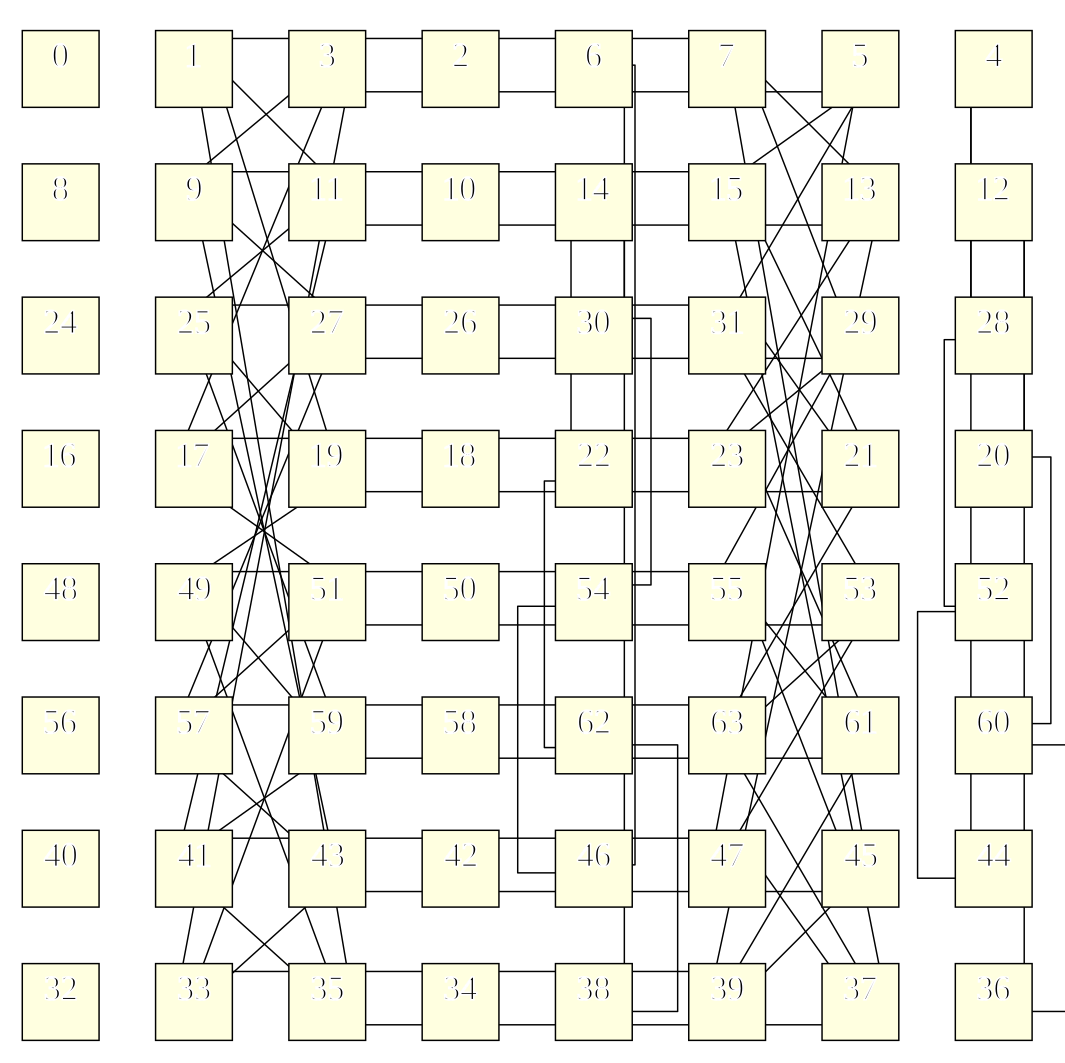
Keeping only the even-dimensional links exposes a regular collection of lower-dimensional components.
Hover a component to identify the corresponding even-dimension structure.
The companion layout makes the repeating toroidal components visible without the visual interference of the full grid.
Hover a component or cell to identify the corresponding CQ-even structure.
CQ-odd view
Hover a colored region in the odd-dimension graph. The site identifies the selected embedded `Q3` copy by its processor labels, turning the picture into a structural query rather than a static illustration.
Hover a highlighted region to reveal one of the embedded Q3 copies.
02 / Structural cut
A useful cut is not just a picture with edges removed. It isolates a chosen family of connections and asks what graph is left behind, which components persist, and how the removed links bridge them.
This view removes the ordinary background of the graph and makes the cross-link family visible on its own. It provides a natural bridge from recursive topology to routing behavior: these are the links that alter which regions can be reached quickly.
03 / Distance consequence
The preceding views describe how the graph is organized. This comparison shows the practical effect: for the tested even dimensions, the crossed cube has lower mean distance than the corresponding hypercube.
Measured values: dimensions 4, 6, 8, 10, 12, 14, 16, 18, and 20. The chart uses the current analytical data set for the standard crossed cube and hypercube.